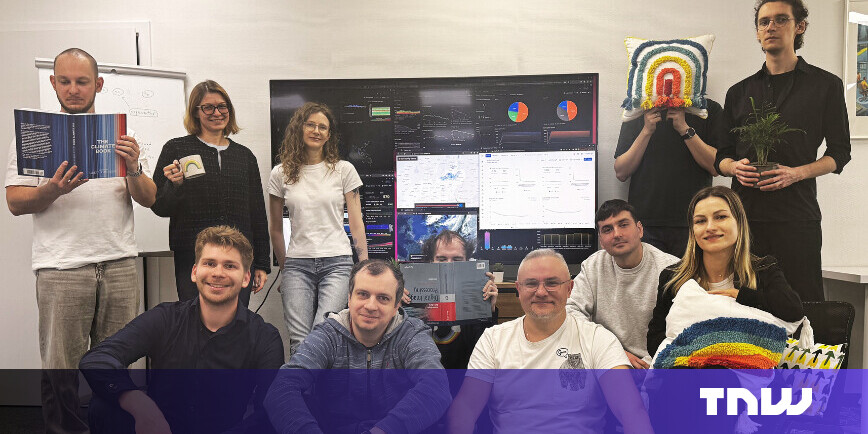
"Warsaw, Poland 26 January 2026 - Rainbow Weather has raised $5.5 million in seed funding to push weather forecasting further into the short-term, high-precision territory it believes the industry still underserves. The Warsaw-based climate tech startup focuses on hyperlocal, minute-by-minute forecasts, zeroing in on what happens in the next few hours rather than days out. The round was backed by a syndicate of investors, including Yuri Gurski, founder of Flo Health, one of Europe's best-known consumer tech unicorns."
"Rainbow Weather's core product is a mobile app that delivers four-hour precipitation forecasts calculated from the exact moment a user checks the weather. Open the app at 3:51 am, and it forecasts conditions through 7:51am, refreshed every 10 minutes and mapped down to a one-square-kilometre grid. That level of temporal and spatial precision is what the company says sets it apart from mainstream weather apps. Most major providers, including AccuWeather, Apple Weather, and The Weather Company, still rely on approaches that either simplify cloud movement or depend on large-scale numerical models designed for longer forecasts."
"Many legacy forecasting providers rely on optical flow for short-term precipitation forecasting. That's a fast but simplistic method that treats clouds as shapes in motion, without any understanding of atmospheric physics," Alexander Matveenko, co-founder of Rainbow Weather. "A second category of services uses large-scale mathematical models that do incorporate physical principles, but they're so cumbersome and slow that they can't respond quickly to real-time weather changes."
Rainbow Weather raised $5.5 million in seed funding to advance hyperlocal, minute-by-minute weather forecasting focused on the next few hours. The Warsaw-based startup's mobile app produces four-hour precipitation forecasts from the exact moment a user checks conditions, updates every 10 minutes, and maps predictions on a one-square-kilometre grid. The approach targets short-term precision that mainstream providers struggle to deliver. Rather than relying solely on optical flow or slow large-scale numerical models, the company uses machine learning to fuse radar, satellite, weather-station, and smartphone barometer data to reduce noise and improve responsiveness to rapid weather changes.
Read at TNW | Sustainability
Unable to calculate read time
Collection
[
|
...
]