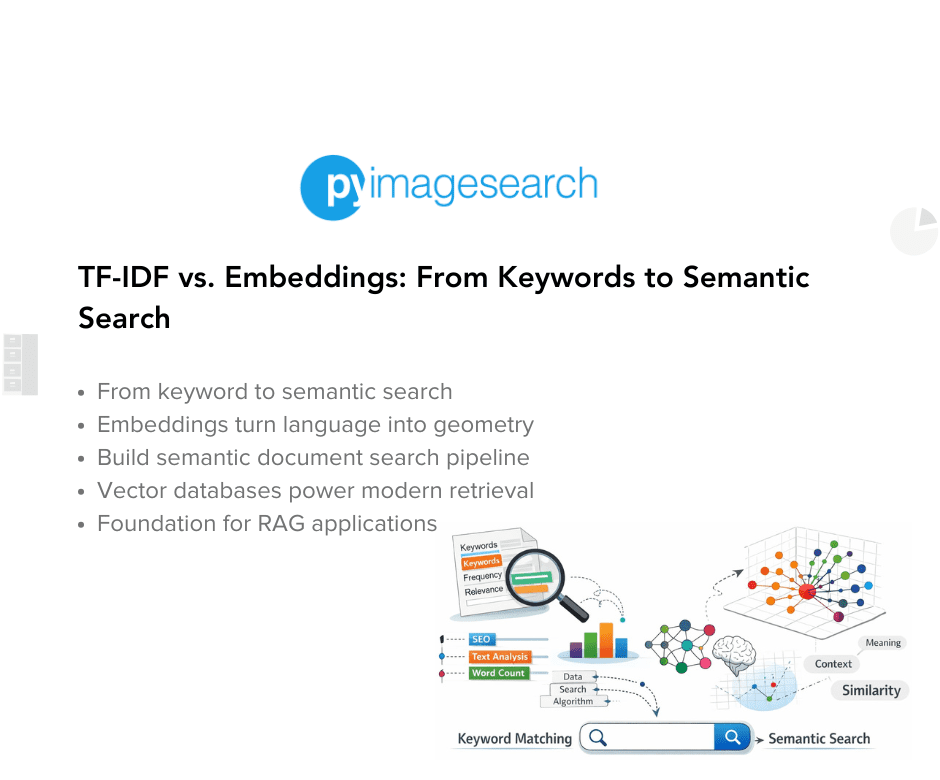
"This 3-part series is your step-by-step journey from raw text documents to a working Retrieval-Augmented Generation (RAG) pipeline - the same architecture behind tools such as ChatGPT's browsing mode, Bing Copilot, and internal enterprise copilots. By the end, you'll not only understand how semantic search and retrieval work but also have a reproducible, modular codebase that mirrors production-ready RAG systems. Each lesson builds on the last, using the same shared repository."
"In this tutorial, you'll learn what vector databases and embeddings really are, why they matter for modern AI systems, and how they enable semantic search and retrieval-augmented generation (RAG). You'll start from text embeddings, see how they map meaning to geometry, and finally query them for similarity search - all with hands-on code. This lesson is the 1st of a 3-part series on Retrieval Augmented Generation:"
Vector databases store numerical embeddings that represent semantic meaning of text as geometric vectors. Embeddings map words, sentences, and documents into high-dimensional space where proximity corresponds to semantic similarity. Similarity search retrieves nearest vectors to a query for semantic search and retrieval-augmented generation (RAG). A three-part pipeline covers generating and visualizing embeddings, building ANN indexes with FAISS, and connecting vector search to a large language model for RAG. A shared repository structure enables reuse of embeddings, indexes, and prompts across lessons. Hands-on code produces a reproducible, modular codebase suitable for production-like RAG systems.
Read at PyImageSearch
Unable to calculate read time
Collection
[
|
...
]