"The gravitational constant, affectionally known as 'Big G,' is one of the most fundamental constants of our universe. Its value describes the strength of the gravitational force acting on two masses separated by a given distance."
"Physicists have a solid ballpark figure for the value of Big G, but they've been trying to measure it ever more precisely for more than two centuries, each effort yielding slightly different values."
"The problem is that gravity is so weak, by far the weakest of the four fundamental forces, so there is significant background noise from the gravitational field of the Earth."
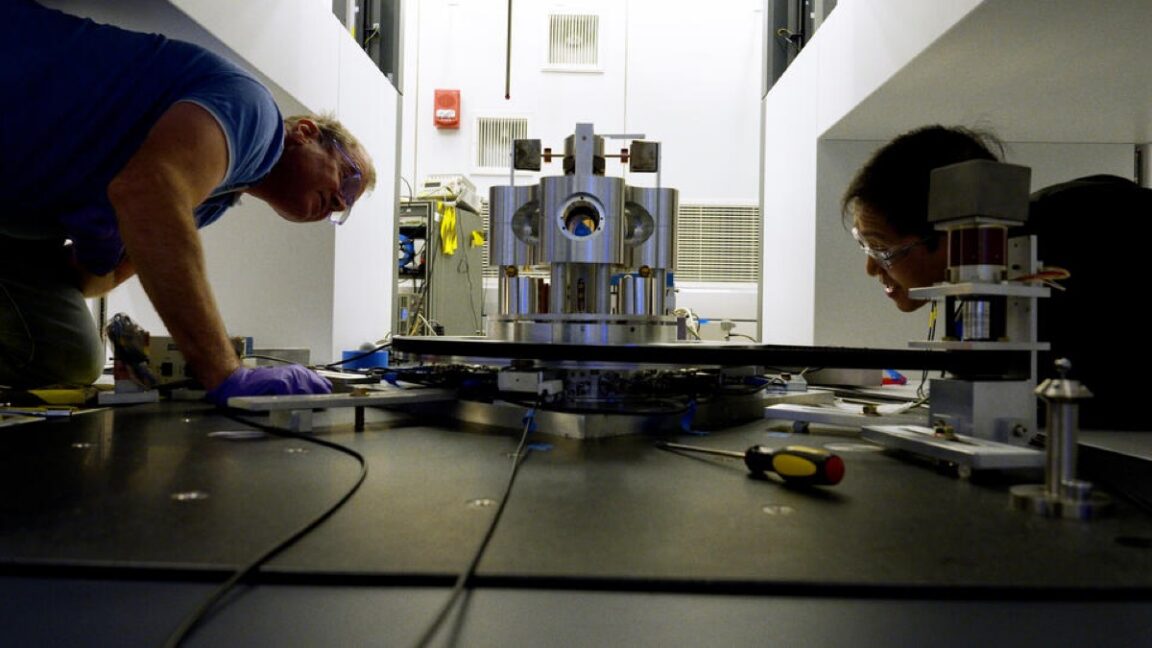
"In the latest effort to resolve the issue, scientists at the National Institute of Standards and Technology (NIST) spent the last decade replicating one of the most divergent recent experimental results."
The gravitational constant, known as Big G, describes the strength of gravity between masses. Despite efforts for over two centuries, its precise measurement varies by one part in 10,000. Other constants are known more accurately, making Big G a point of frustration for physicists. The weakness of gravity leads to significant background noise, complicating laboratory measurements. Recent efforts by scientists at NIST aimed to replicate divergent experimental results, providing another data point but not resolving the discrepancies in Big G's value.
Read at Ars Technica
Unable to calculate read time
Collection
[
|
...
]