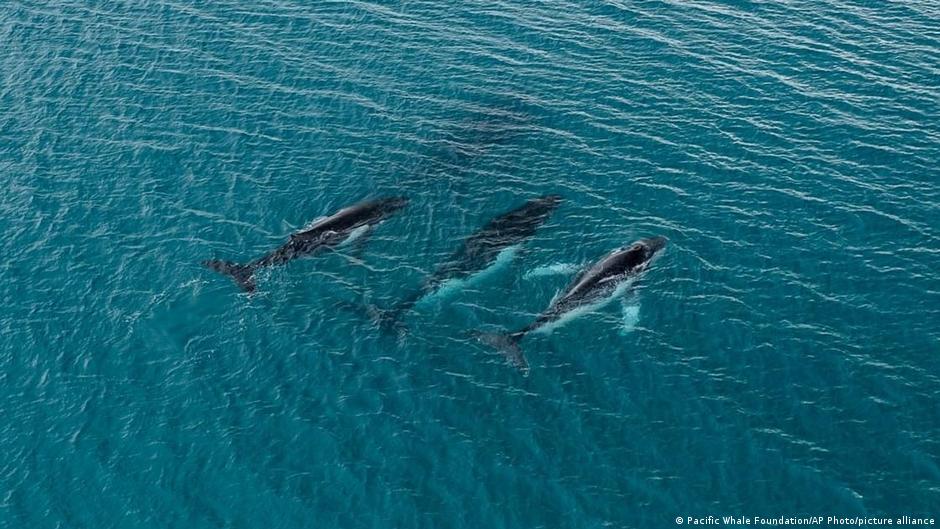
"Two humpback whales have been sighted in separate breeding grounds off Australia and Brazil, the first time scientists have seen the species travel such vast distances across the Southern Ocean during their lifetimes. An article published in the Royal Society Open Science journal on Wednesday is the upshot of using tens of thousands of images of the sea-dwelling mammals' unique tails (or flukes) to identify the creatures and their movement habits. Somewhat like human fingerprints, the markings on humpback whales' flukes or tails are unique, making it possible to identify individuals from photo records"
"One whale was spotted in Queensland, off Australia's eastern coast, in 2007 and then again in 2013. It subsequently appeared near Sao Paulo, Brazil, in 2019 two points separated by roughly 14,200 kilometers (8,823 miles). The other whale was first observed off the coast of Bahia in Brazil in 2003, and then 22 years later off Hervey Bay in Queensland, 15,100 kilometers away. The study said that it was not possible to record how much distance the whales had actually covered on their journeys, because their figures "reflect the separation between sighting locations rather than actual distances traveled, as photo-identification records only the endpoints of each individual's travel.""
"The researchers said that the findings extended the known spatial limits of inter-basin connectivity for southern hemisphere humpbacks, supporting the "Southern Ocean Exchange hypothesis" that the species could meet on shared Antarctic feeding grounds and then in exceptional cases follow a different route back to a breeding ground. The whales feed on krill and small fish in colder waters during the warmer summer mont"
Two humpback whales were identified in separate breeding grounds off Australia and Brazil, with sightings spanning about 14,200 and 15,100 kilometers. One whale was seen off Queensland in 2007 and 2013, then near Sao Paulo in 2019. The other whale was first observed off Bahia in 2003, then 22 years later off Hervey Bay in Queensland. The study could not measure total travel distance because photo-identification records only the endpoints of each whale’s movements. Climate change may be altering ocean conditions, including sea ice and prey locations, which could influence movement patterns. The results expand known inter-basin connectivity limits and support the Southern Ocean Exchange hypothesis, where whales may meet on shared Antarctic feeding grounds and sometimes return via different routes.
Read at www.dw.com
Unable to calculate read time
Collection
[
|
...
]