"Records, introduced in Java 16, provide a concise way to model immutable data carriers. A record declaration such as: record Point(int x, int y) { } It automatically defines a canonical constructor, accessor methods, and implementations of , , and . Records also participate in deconstruction patterns for use with instanceof and . Combined with sealed classes and pattern matching, records support modelling algebraic data types in Java."
"Such response hierarchies can then be handled using exhaustive pattern matching: static String handle(HttpResponse response) { return switch (response) { case Success(var code, var body) -> "OK (" + code + "): " + body; case NotFound(var msg) -> "404: " + msg; case ServerError(var code, var err) -> "Error (" + code + "): " + err; }; } In this example, the compiler ensures that all permitted response types are covered. If a new response variant is introduced, the switch expression must be updated to reduce the risk of incomplete error handling."
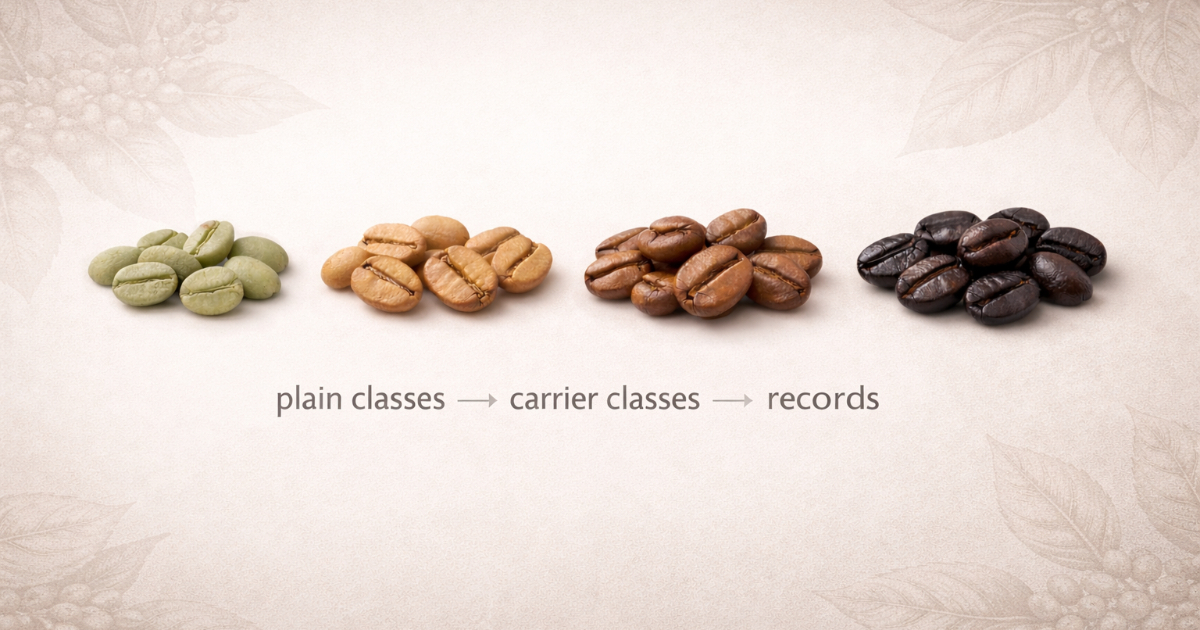
Carrier classes and carrier interfaces generalize the core benefits of records while allowing more flexible class designs without strict representation rules. Records introduced in Java 16 provide a concise way to model immutable data carriers and automatically define canonical constructors, accessor methods, and standard implementations for common object operations. Records participate in deconstruction patterns usable with instanceof and pattern matching. Combined with sealed classes and pattern matching, records enable modelling algebraic data types as sealed hierarchies of variants. Sealed interfaces with record variants can be handled by exhaustive switch pattern matching, and the compiler enforces coverage, requiring updates when new variants are added.
Read at InfoQ
Unable to calculate read time
Collection
[
|
...
]