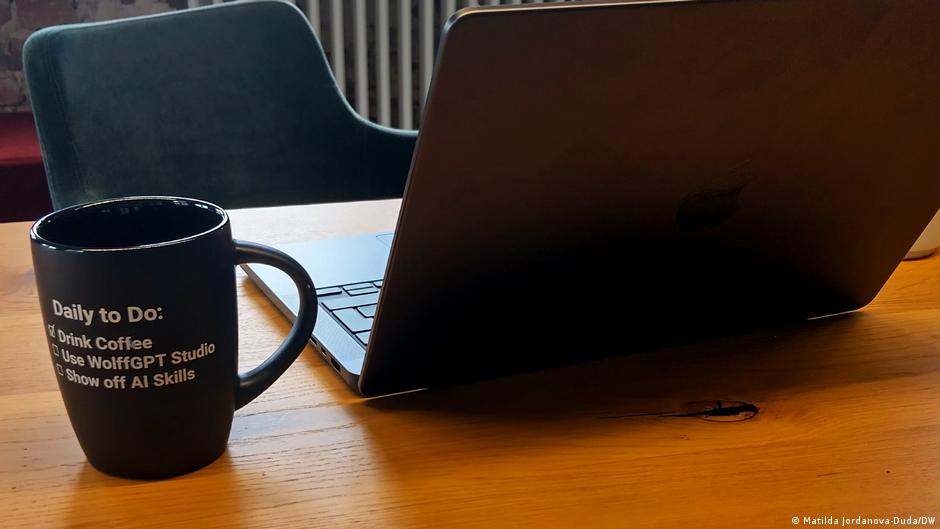
Inna Hilgenberg manages scheduling and instructions for the filling and packaging department while ensuring hygiene and safety standards. She uses WolffGPT daily to write workflows, design presentations, and edit Word files and Excel spreadsheets. She finds AI helpful because writing instructions during busy production tasks is difficult. Many employees wanted to use ChatGPT at work, but company data cannot be shared with public large language models. Dr. Wolff therefore developed an in-house AI model based on existing LLMs, connected to selected company systems and data so sensitive information remains protected. In Germany, larger companies use AI more often, and manufacturers commonly use it to generate texts, images, and code. Surveys show many companies already use AI or plan to adopt it to improve productivity and efficiency under competitive pressure.
"“We are busy enough with the production side of things,” Inna Hilgenberg told DW. She's the deputy head of the packaging department at Dr. Wolff, a Bielefeld-based midsize cosmetics and pharmaceutical company. Behind her, black and red shampoo bottles are filled while they glide down the conveyor belt. “Writing instructions while busy with these tasks is not that easy,” she added. That's why Hilgenberg has come to appreciate her company's very own artificial intelligence (AI)tool WolffGPT, which she uses practically every day."
"Her job involves scheduling and instructing staff in the filling and packaging department, as well as ensuring hygiene and safety standards are met. She relies on WolffGPT to write workflows, design presentations edit Word files and Excel spreadsheets. “I only see advantages in AI,” she told DW. Inna Hilgenberg is very satisfied with the use of AI at Dr. WolffImage: Matilda Jordanova-Duda/DW Many of the company's employees had already started using ChatGPT in their free time and would have liked to use it at work too."
"However, no company data can be shared with public large language models, or LLMs. That's why Dr. Wolff developed an in-house AI model on the basis of existing LLMs. It's connected to selected company systems and data and, therefore, sensitive company data remains protected. In Germany, large companies are more likely to use AI than smaller ones. Manufacturers most commonly make use of AI to generate texts, images and code, according to a future technologies study conducted by ifaa, a Dusseldorf-based institute of applied work science."
"The study found that over 40% of companies surveyed already use AI, with 37% planning to do so. Increasing competitive pressure is forcing many small and medium-sized enterprises (SMEs) in the manufacturing sector to consider using AI to boost productivity and efficiency, according to the IfM, a German institute that looks into small and medium-sized enterprises. It fo"
#ai-in-manufacturing #in-house-ai-models #data-privacy #packaging-operations #productivity-and-efficiency
Read at www.dw.com
Unable to calculate read time
Collection
[
|
...
]