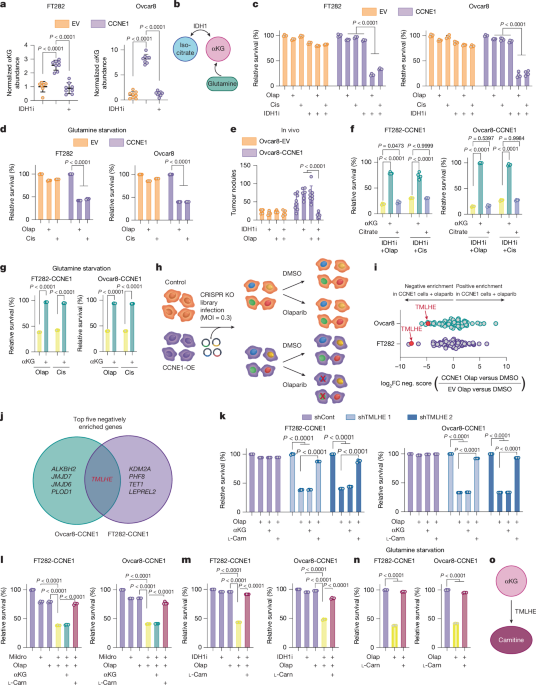
DNA double-strand break repair requires accurate and efficient cellular repair mechanisms to maintain genome stability. In cancer, DNA-repair pathways are frequently dysregulated, and many tumors show homologous recombination deficiency, making them more sensitive to DNA-damaging therapies. Tumors that retain homologous recombination proficiency are often more resistant, including those with high endogenous CCNE1 expression that encodes cyclin E1. The basis for homologous recombination proficiency, including roles of CCNE1 and other oncogenes, remains unclear. Histone tail post-translational modifications regulate DNA DSB repair and are metabolically sensitive. αKG-dependent dioxygenases connect metabolism and epigenetics by using αKG to catalyze hydroxylation reactions on DNA and histone substrates, producing succinate. Cancer-associated metabolic changes can alter αKG abundance or inhibit αKG-dependent dioxygenase activity, affecting DNA repair and drug sensitivity.
"The ability of cells to repair DNA damage accurately and efficiently, especially DNA double-strand breaks (DSBs), is crucial for genome stability3. In cancer, DNA-repair pathways are often dysregulated4,5. HR is deficient in many tumours, leading to increased sensitivity to DNA-damaging agents that are used widely in clinical settings. Notably, HR-proficient tumours are often harder to treat, owing to their intrinsic resistance to DNA-damaging agents1."
"For instance, tumours with high endogenous CCNE1 expression, which encodes the oncogene cyclin E1, are HR proficient and inherently resistant to DNA-damaging agents6. The mechanisms underlying HR proficiency in general, and in the context of CCNE1 and other oncogenes, remain unclear."
"Histone tail post-translational modifications (PTMs) have a crucial role in many fundamental cellular processes, including DNA DSB repair7,8,9. Histone PTMs are metabolically sensitive10. For instance, αKG, also known as 2-oxoglutarate (2OG), is a co-substrate for αKGDDs that include DNA and histone demethylases2. αKGDDs are a superfamily of enzymes that reside at the intersection of metabolism and epigenetics, and have crucial roles in many biological processes."
"They catalyse hydroxylation reactions on various substrates, consuming αKG and producing succinate. Alteration of several metabolic enzymes and pathways that affect αKG abundance and αKGDD activity have been reported in cancer, such as mutations of the genes encoding isocitrate dehydrogenase 1 and 2 (IDH1 and IDH2), changes in glutaminolysis that deplete αKG, and alterations in fumarate hydratase and succinate dehydrogenase that inhibit αKGDD activity11. Previous work has found that oncometabolites that suppress αKGDD activity affect DNA repair and sensitivity to DNA-damaging agents12,13,14,15,16,17,18."
#dna-double-strand-break-repair #homologous-recombination #ccne1cyclin-e1 #kg-dependent-dioxygenases #cancer-metabolism-and-epigenetics
Read at Nature
Unable to calculate read time
Collection
[
|
...
]