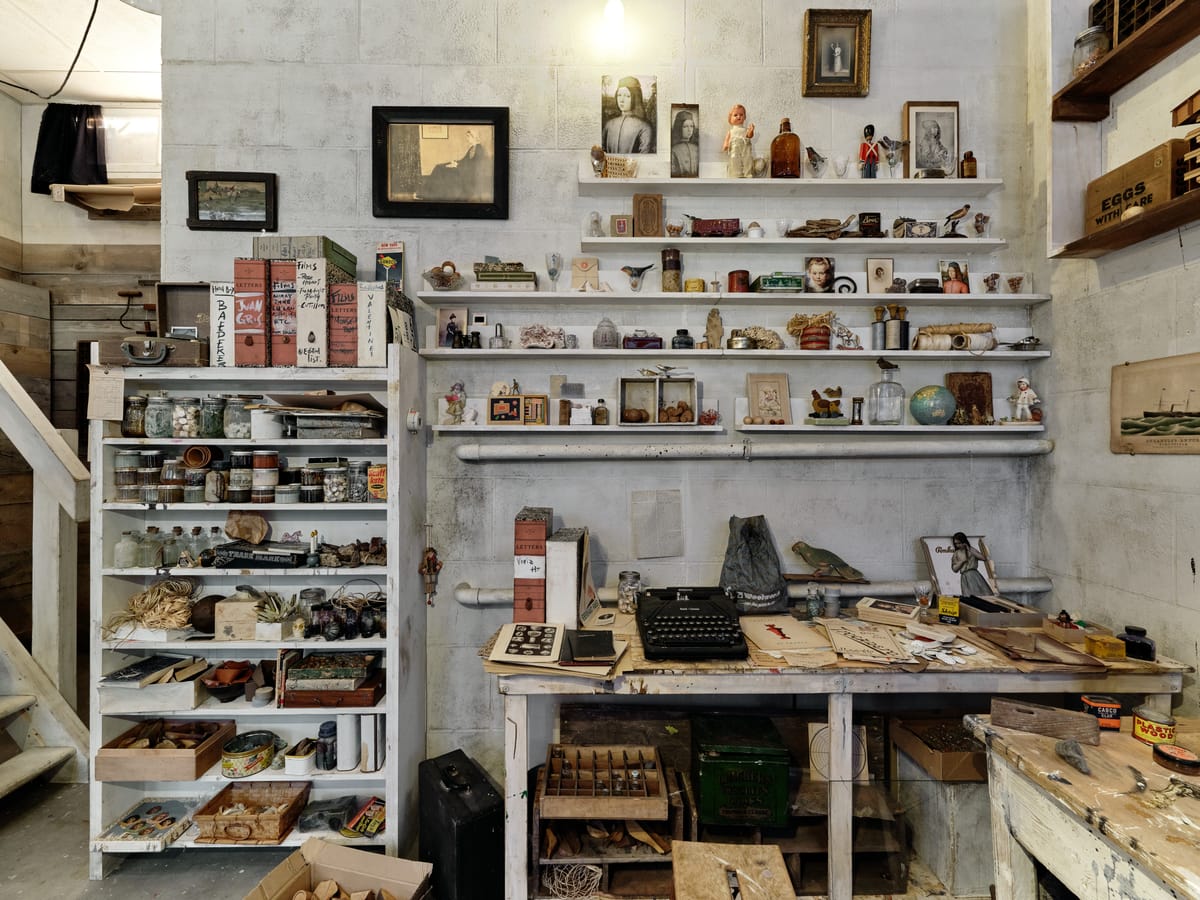
"Even without any formal art background, Joseph Cornell was an expert collector and curator of found materials and curios. His influential shadow boxes, lovingly composed from mementos, curios, images clipped from their literature, and ordinary or ephemeral objects that he came across, became dimensional worlds of wonder that laid the foundations for assemblage and installation art. The source material of those worlds, squirreled away in storage boxes or stacked on nearly every surface in Cornell's basement studio at his home along Utopia Parkway in Queens,"
"Gagosian curator Jasper Sharp and filmmaker Wes Anderson co-developed the exhibition at the gallery's storefront location in Paris, the city Cornell knew intimately and deeply longed for, but ultimately never visited. "The location itself could not be more fitting: Paris was a place Cornell dreamed of his entire life," Sharp said of The House on Utopia Parkway: Joseph Cornell's Studio Re-Created by Wes Anderson, on view through March 14, in an essay about the show."
Wes Anderson and curator Jasper Sharp reconstructed Joseph Cornell's basement studio from Utopia Parkway inside Gagosian's Paris storefront, recreating dense arrays of storage boxes, surfaces piled with found materials, and assembled curios. Cornell collected mementos, ephemera, clipped images, and ordinary objects to compose influential shadow boxes that created dimensional worlds and helped found assemblage and installation practices. The installation emphasizes Cornell's deep personal attachment to Paris, a city he long dreamed of but never visited. An anecdote recounts a conversation with Marcel Duchamp in which Cornell revealed he had never visited Paris, leaving Duchamp speechless. The exhibition runs through March 14.
Read at Hyperallergic
Unable to calculate read time
Collection
[
|
...
]