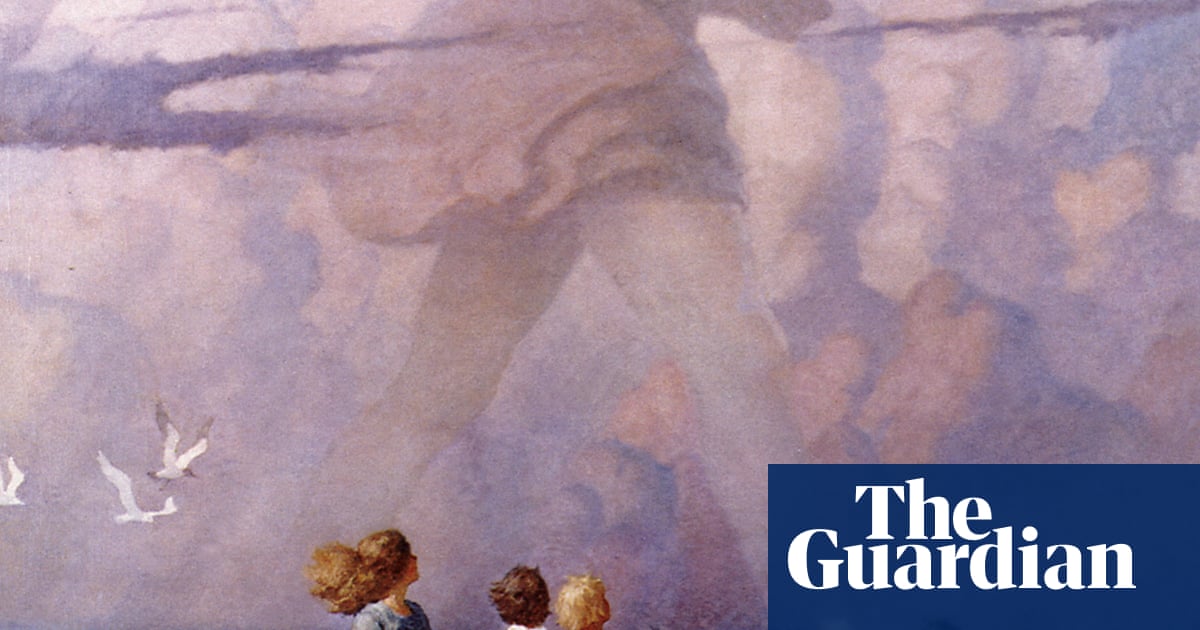
"The low angle emphasises the giant's immensity, and all the children's faces are turned away from the viewer. In this way, those children become anyone we care to transpose into this magical scene. What child has not lain in the grass to watch some cloud-image, an animal perhaps, gradually dissolve into the amorphous collection of water droplets that are its banal reality? Why has Wyeth instilled this sense of nostalgic impermanence into his painting about imagination?"
"Almost every corner of western society views imagination as the domain of early childhood, those fleeting years when giants made of cloud seem possible. This explains why the word imagination disappears from Victorian education department curriculum documents well before children reach high school not that it appears much prior to that. Worse, most of us know instinctively that, in many adult contexts, the word's connotations are at best ambivalent and at worst outright negative."
"Even being labelled a dreamer is rarely a compliment; when we laugh that something might happen only in one's dreams, we seem to be mocking not only an individual's hopes, but their time spent building such imaginative constructions in the first place. All this language and associated behaviour is an ostensibly pragmatic attempt to wrench people back to direct engagement with what western society views as the real and thus far more importantly the useful."
"Today, true imagination that is, untethered dreaming for the nourishment of the self has become a radical act The truth is that all very young children do have ric"
Six children sit at a waterline in roaring wind while seagulls strain against gusts and waves move below. A very young girl looks toward a distant horizon where a giant strides past, rendered with a low angle that makes the figure seem immense. The children’s faces are turned away, making them stand in for any viewer’s imagined childhood. The scene connects imagination to early childhood experiences such as watching clouds or animals dissolve into ordinary reality. Imagination is treated as temporary and is removed from later education, while adult language often frames dreamers negatively. Imagination becomes a radical act when it is untethered from practical usefulness.
Read at www.theguardian.com
Unable to calculate read time
Collection
[
|
...
]