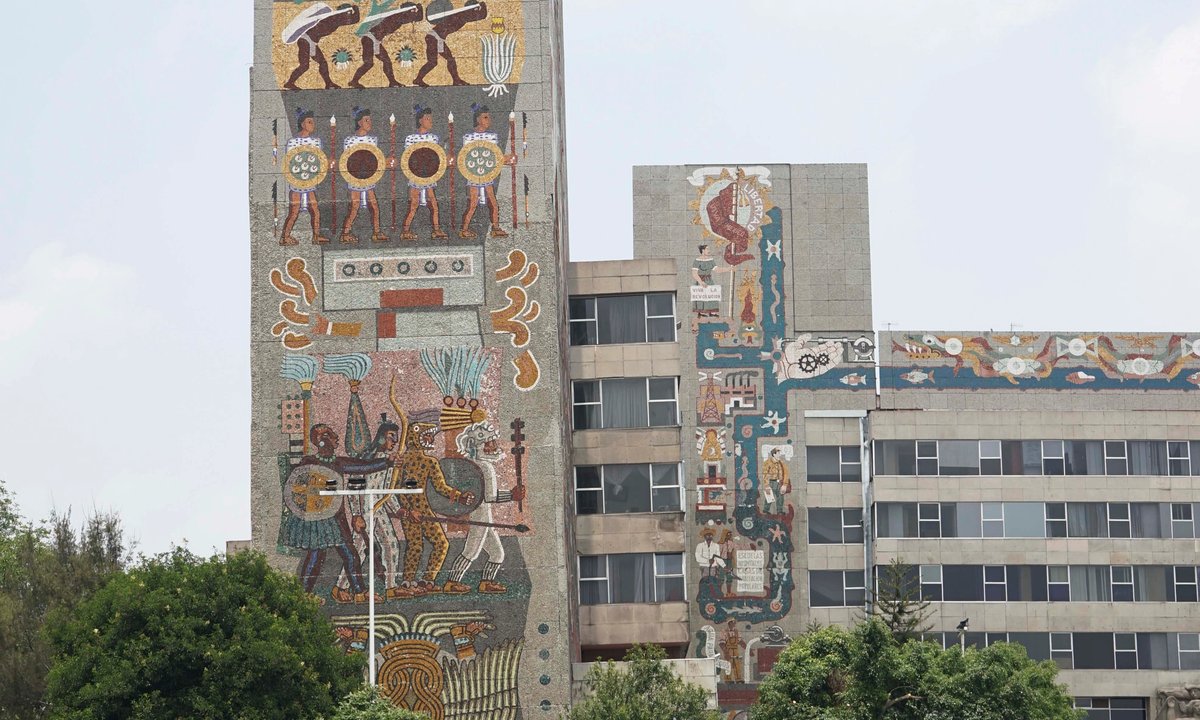
"How does one protect heritage that no longer exists as it was intended? This is one of many questions surrounding the 6,000 sq. m of stone mosaic murals, sculptures and reliefs that once adorned Centro SCOP, the former headquarters of Mexico's Ministry of Communications and Public Works. Inaugurated in 1954 in Mexico City, the site was home to one of the world's largest groups of mosaic murals, but it suffered greatly from major earthquakes in 1985 and 2017."
"Centro SCOP embodies Mexico's 1950s "plastic integration", combining art with functionalist architecture for social purposes-a theoretical approach central to Muralism, whose most well-known practitioner early on was Diego Rivera. At Centro SCOP, Mexican artists like Juan O'Gorman-who worked on the famous stone mosaic murals at the National Autonomous University of Mexico's (UNAM) library-along with José Chávez Morado and others, created an intricate narrative of national identity across more than a dozen murals. Made using local stones from different regions embedded into concrete panels, the works drew on both pre-Hispanic motifs and Modernism."
Centro SCOP housed some of the world's largest groups of stone mosaic murals, sculptures and reliefs across 6,000 sq. m, inaugurated in 1954 in Mexico City. The complex combined art and functionalist architecture under the 1950s principle of "plastic integration," linking Muralism, national identity narratives and social-purpose design. Artists including Juan O'Gorman and José Chávez Morado used local stones and pre-Hispanic motifs within Modernist frameworks. The site and its adjacent residential complex suffered major damage in the 1985 and 2017 earthquakes; structural instability after 2017 led to demolition and removal of the murals, which are now in storage and without a secured future.
Read at The Art Newspaper - International art news and events
Unable to calculate read time
Collection
[
|
...
]