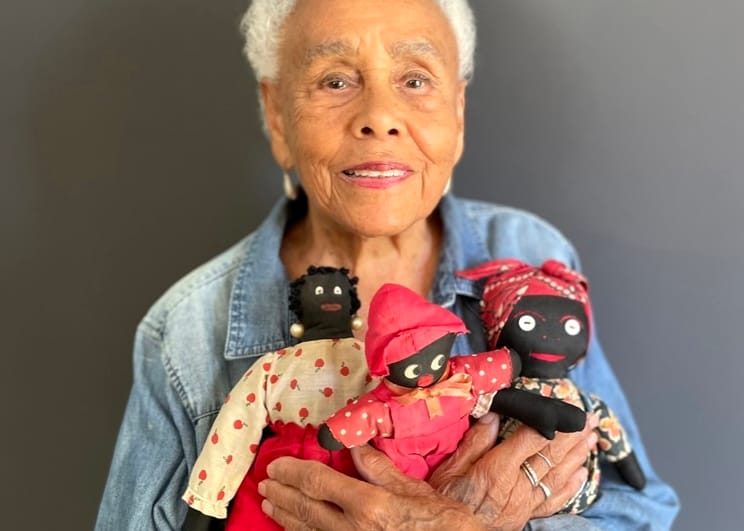
Betye Saar has gathered ephemera such as taxidermied animals, cages, and computer parts throughout her life. Since the 1970s, she has transformed found objects into assemblage artworks that challenge racist artifacts and imagery, including “The Liberation of Aunt Jemima” from 1972. Her studio contains many collected items from nature, travel, and flea markets, including a cherished shelf of Black dolls she calls a “family.” An exhibition in New York City presents some of these dolls alongside related paintings, prints, and sculptures. The show marks Saar’s promised gift of over 100 dolls to the New York Historical near her 100th birthday. Saar’s childhood lacked Black dolls, and her first doll appeared in 1949 while she was a college student.
"Betye Saar has been accumulating ephemera - taxidermied animals, cages, computer parts, and more - throughout her life. Since the 1970s, she has crafted these found objects into assemblage artworks that often subvert racist artifacts and images, beginning with her famed sculpture “The Liberation of Aunt Jemima” (1972). “I knew I could not avoid the pain, so it became part of my art,” she said in 1973, as quoted in the monograph Black Doll Blues."
"Today, her studio is filled to the brim with objects and ephemera gathered from nature, on her international travels, and at flea markets. On one special shelf sits her cherished collection of Black dolls. Some of these dolls, which Saar calls a “family,” have traveled to New York City, where they are now on view through October 4 at the New York Historical alongside paintings, prints, and sculptures featuring figurines."
"Near the occasion of her upcoming 100th birthday, the exhibition celebrates Saar's promised gift of her collection of over 100 dolls to the institution. While the artist, over the years, has considered cleaning out her studio, “the dolls are the one thing she can't discard,” Wendy Nālani E. Ikemoto, vice president and chief curator of the New York Historical and the exhibition's co-curator, told Hyperallergic. “It is very meaningful that she's entrusting us with these dolls,” added co-curator Rebecca Klassen."
"Born in 1926, Saar never had a Black doll of her own to play with as a girl. She came across her first as a college student in 1949 - an Amosandra doll - and became enthralled by them. She began incorporating them into her art practice in the 1970s, and they have figured into her work ever since, appearing in assemblages like “Indigo Mercy”"
Read at Hyperallergic
Unable to calculate read time
Collection
[
|
...
]