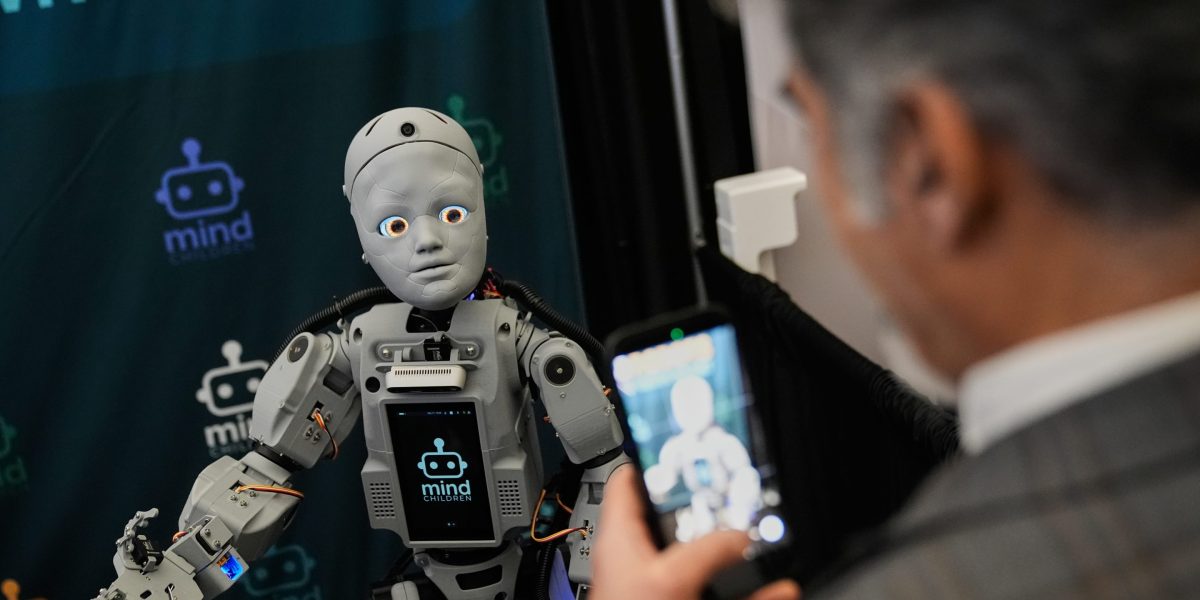
"Robots have long been seen as a bad bet for Silicon Valley investors - too complicated, capital-intensive and "boring, honestly," says venture capitalist Modar Alaoui. But the commercial boom in artificial intelligence has lit a spark under long-simmering visions to build humanoid robots that can move their mechanical bodies like humans and do things that people do. Alaoui, founder of the Humanoids Summit, gathered more than 2,000 people this week, including top robotics engineers from Disney, Google and dozens of startups,"
"Disney's contribution to the field, a walking robotic version of "Frozen" character Olaf, will be roaming on its own through Disneyland theme parks in Hong Kong and Paris early next year. Entertaining and highly complex robots that resemble a human - or a snowman - are already here, but the timeline for "general purpose" robots that are a productive member of a workplace or household is farther away."
""The humanoid space has a very, very big hill to climb," said Cosima du Pasquier, co-founder of Haptica Robotics, which works to give robots a sense of touch. "There's a lot of research that still needs to be solved." The Stanford University postdoctoral researcher came to the conference in Mountain View, California, just a week after incorporating her startup. "The first customers are really the people here," she said."
Robots were long regarded as a poor investment due to complexity, capital intensity and lack of excitement. The commercial boom in artificial intelligence has renewed ambition to build humanoid robots capable of humanlike movement and tasks. The Humanoids Summit attracted over 2,000 participants, including engineers from Disney and Google, to showcase prototypes and discuss industry acceleration. Disney plans to deploy a walking robotic Olaf in Disneyland parks next year. Entertaining humanlike and character robots exist, but general-purpose workplace or household robots remain distant. Researchers emphasize significant research challenges and a long timeline before humanoids become broadly useful.
Read at Fortune
Unable to calculate read time
Collection
[
|
...
]