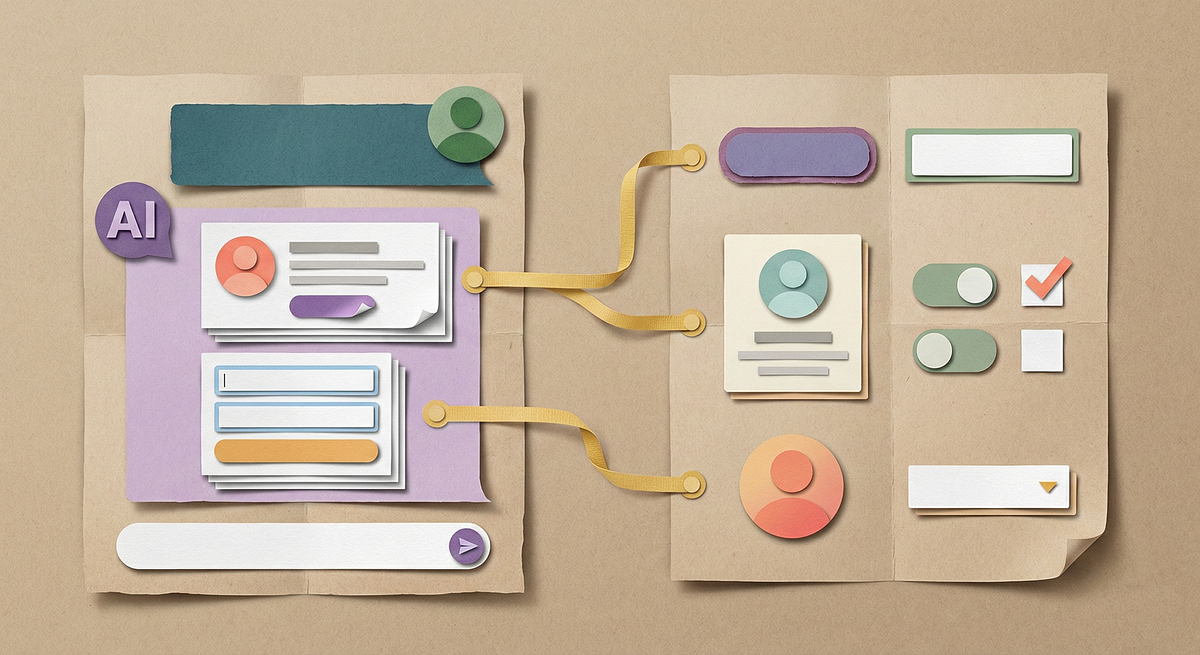
"LLMs have made AI assistants a standard feature across SaaS. AI assistants allow users to instantly retrieve information and interact with a system through text-based prompts. Mathias Biilmann, in his article " Introducing AX: Why Agent Experience Matters," discusses two distinct approaches to building AI assistants. The Closed Approach involves a conversational assistant embedded directly within a single SaaS product. Examples include Zoom's AI Companion, Salesforce CRM's Einstein, and Microsoft's Copilot. The Open Approach involves external conversational assistants, such as Claude, ChatGPT, and Gemini,"
"Both approaches are powerful. They offer users flexibility they've never had. However, they also reduce the carefully crafted user experience to a purely text-based interface. When the interaction is text-only and detached from your product, the user experience is no longer a differentiator, and your product is at risk of becoming a commodity. Text-only interfaces also limit interactions to simple information retrieval and basic CRUD operations, making complex workflows difficult."
LLMs enabled AI assistants across SaaS, allowing instant information retrieval and text-driven interaction. Two approaches exist: closed, product-embedded conversational assistants and open, external assistants that connect to products via protocols like MCP. Both approaches give unprecedented flexibility but can reduce the user experience to a text-only layer, eroding product differentiation and risking commoditization. Text-only interfaces constrain interactions to simple retrieval and CRUD, complicating complex workflows and large-volume information consumption. Humans prefer visual information, and chat often poorly fits complex interaction patterns. Generative UI, where AI autonomously builds interfaces from prompts, is emerging as a potential response.
Read at Medium
Unable to calculate read time
Collection
[
|
...
]