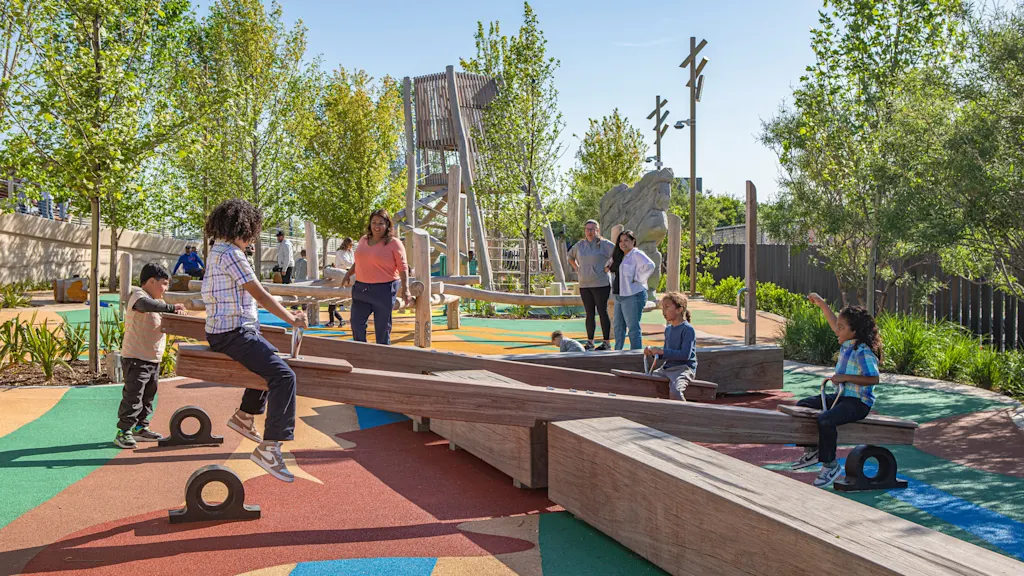
"The $300 million freeway capping project includes a playground, splash pad, band shell, large lawn, and linear walkway that resurrects an erased section of a historic street. Joining the widely celebrated freeway-capping Klyde Warren Park, which opened its first phase over a stretch of a recessed downtown freeway in 2012, Halperin Park is a community-centric model for addressing the divisions wrought by highway building."
"Designed by architecture firm HKS and landscape architecture firm SWA, the cap park reconnects part of Oak Cliff, a South Dallas neighborhood cut up by the 1950s-era highway-building boom. At the time I-35E was constructed, Oak Cliff was home to a thriving Black community. As in many other non-white neighborhoods in cities across the country, the community was shattered by highway construction and the decades of disinvestment that followed."
"While it's a park to reconnect communities, it's also a park that we wanted the communities to feel like they helped design; they helped influence the programming. During the planning process, a "community-first plan" was developed through extensive outreach, focusing the project on outcomes like improving access for schools in the surrounding area, increasing shade, and reducing the heat island effect in the neighborhood."
"As it officially opens, the 2.8-acre park is forging a small but meaningful reconnection in the area. Its design honors the neighborhood's history while also encouraging the economic development it needs. The park features a mixture of uses. Kids can scramble up the jungle gym or cool off on the splash pad."
Halperin Park is a $300 million freeway-capping development in Oak Cliff, Dallas, built over 14 lanes of interstate traffic and opened to the public. The 2.8-acre park includes a playground, splash pad, band shell, large lawn, and a linear walkway that restores a previously erased historic street. Designed by HKS and landscape architecture firm SWA, the project reconnects a South Dallas neighborhood cut apart by 1950s-era highway construction and subsequent disinvestment. A community-first planning process used extensive outreach to shape programming and outcomes such as improved school access, increased shade, and reduced heat island effects. The park blends recreation with support for local economic development while honoring neighborhood history.
Read at Fast Company
Unable to calculate read time
Collection
[
|
...
]