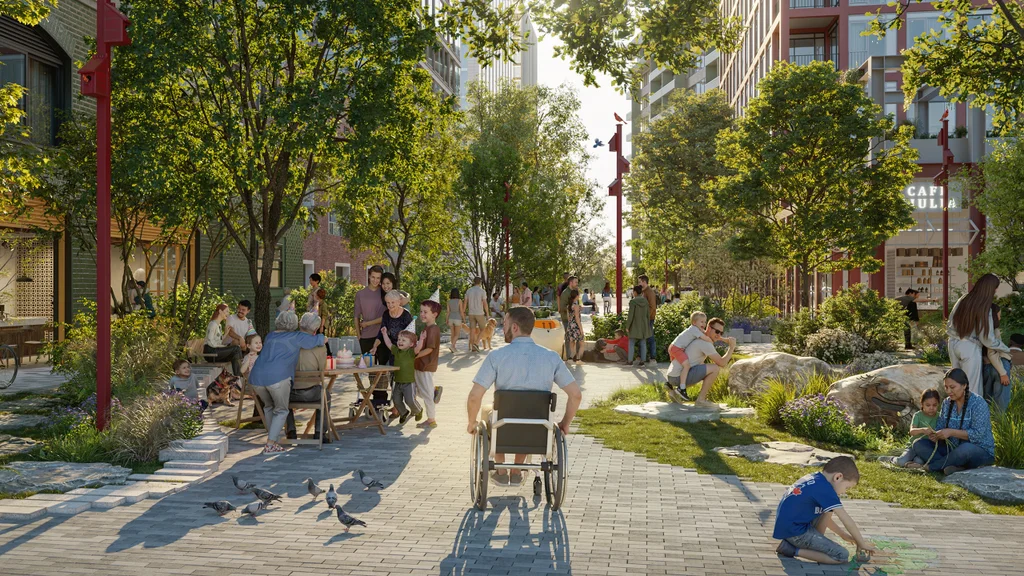
A new Toronto neighborhood uses streets to provide parks and plazas instead of reserving separate land for them. The main street is car-free and functions like a linear park with about 400 trees. Other streets allow cars but prioritize extensive green space. The design creates public space for residents while acting as climate infrastructure that can lower urban heat, support biodiversity, and capture stormwater during heavy rainfall. The neighborhood sits on former industrial land near the Don River and Lake Ontario, where earlier channelization and wetland infill caused pollution and flooding. A long redevelopment project cleaned the waterfront, reshaped the river, added green flood protection, and created an island for the new neighborhood.
"The main street will be car-free, "like a linear park," he says, and filled with 400 trees. Other streets will allow cars, but prioritize large swaths of green space. The design gives residents public space, and doubles as climate infrastructure that can reduce urban heat, support biodiversity, and capture water in storms."
"Instead of carving out room for parks and plazas, they made the streets do that work instead. "The street is almost like a public courtyard," says Rasmus Astrup, design principal and senior partner at SLA, the Denmark-based firm that was part of the design team for the new neighborhood, called Ookwemin Minising."
"The area, south of downtown Toronto where the Don River meets Lake Ontario, used to be industrial. More than a century ago, the city channelized part of the river and filled in wetlands to make room for factories. The old infrastructure didn't work well: The river and industrial zone became polluted and the changes to the river led to more flooding."
"The original plan for the neighborhood, released two years ago, called for more typical North American streets-wide and built for cars, lined with blocks of uniform apartment buildings. After negative community feedback, the public development agency running the project, Waterfront Toronto, realized that the neighborhood needed more apartments to help deal with Toronto's housing shortage. It brought in a new design team, including SLA, and asked them to come up with a new plan that would increase density by 27%."
#urban-planning #green-infrastructure #housing-density #stormwater-management #toronto-waterfront-redevelopment
Read at Fast Company
Unable to calculate read time
Collection
[
|
...
]