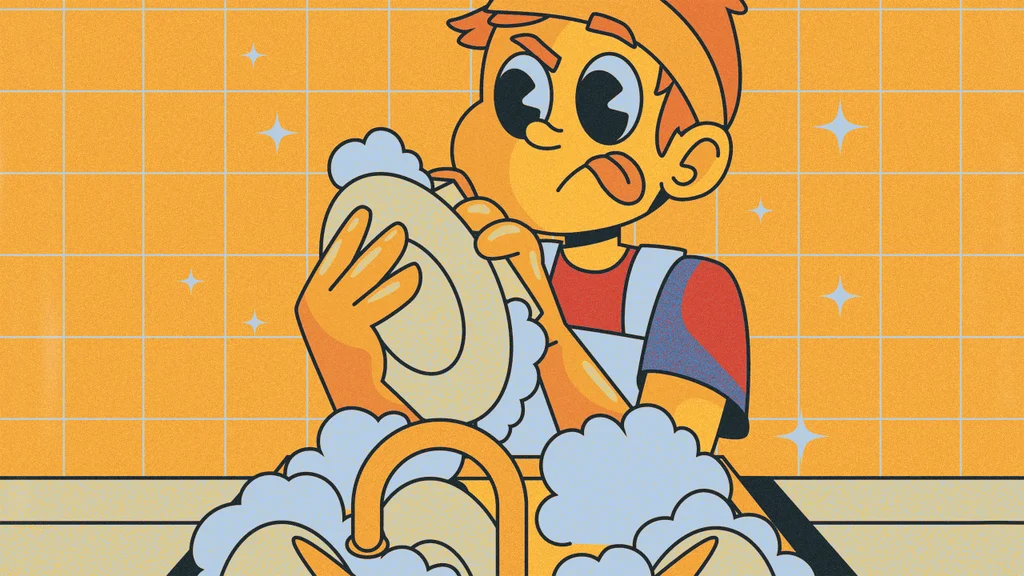
Effective cleaning relies on four interdependent factors: chemistry, temperature, mechanics, and time. Changing one factor can compensate for a deficit in another, keeping the system in dynamic balance. Dish soap works because its surfactant molecules have two sides: one adheres to oils and the other to water, bridging incompatible substances so they can be combined and rinsed away. In collaboration, chemistry corresponds to the catalyst introduced at the start, especially the quality of the question asked. A mediocre question yields mediocre engagement, while a generative question connects to what people already know and draws them toward what they do not yet understand, creating conditions for ideas to form.
"It holds that effective cleaning depends on four interdependent factors: chemistry, temperature, mechanics, and time. Adjust any one of them-increase the temperature, extend the time-and you can compensate for a deficit in another. They form a closed loop, a system in dynamic balance."
"The reason dish soap works so well is elegantly simple: a surfactant, the active molecule in soap, is two-sided. One end adheres to oils, the other to water. It acts as a bridge, allowing what was previously incompatible to combine and be rinsed away together."
"What struck me was this: The same four forces govern whether human collaboration cleans up or leaves a mess."
"In collaboration, the equivalent of chemistry is the catalyst you introduce at the start of the process. Specifically, it's the quality of the question you ask. A mediocre question produces mediocre engagement. But a generative question, like a surfactant, has two sides: It adheres to what people already know and simultaneously pulls them toward what they don't yet understand."
Read at Fast Company
Unable to calculate read time
Collection
[
|
...
]