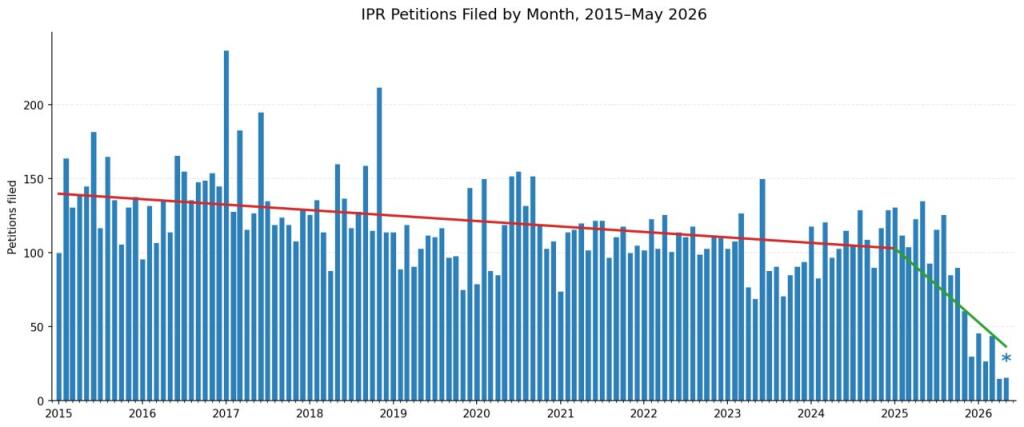
IPR petitions filed per month stayed mostly between 100 and 185 from 2015 through 2024, with a gently downward long-run trend. Filings then fell dramatically starting in 2025, reaching the lowest levels since the AIA post-grant review system became fully operational. In 2025, institution rates collapsed after Director Squires assumed personal control of all institution decisions in October 2025 and denied petitions at a rate approaching zero. In 2026, practitioners responded to the changed incentives, concluding that if petitions are denied at the front end regardless of merit, the cost-benefit calculus no longer supports filing. The original IPR model as a cost-effective alternative to district court litigation for patent validity challenges is functionally suspended.
"The chart above tracks IPR petitions filed by month from 2015 through May 2026. For most of that decade, filings hovered in a band between 100 and 185 per month, with a long-run trend line sloping gently downward. Then something dramatic happened: beginning in 2025 , filings fell off a cliff. The numbers for 2026 are the lowest since the AIA's post-grant review system was fully operational."
"The story of 2025 was collapsing institution rates. Director Squires assumed personal control of all institution decisions in October 2025 and proceeded to deny petitions at a rate approaching zero. The story of 2026 is the market's response. Practitioners have done the math: if IPR petitions are denied at the front end regardless of merit, the cost-benefit calculus no longer works."
"The IPR system, at least in its original form as a cost-effective alternative to district court litigation for challenging patent validity, is functionally suspended."
#ipr-petitions #patent-validity-challenges #institution-rates #aia-post-grant-review #district-court-litigation
Read at Patently-O
Unable to calculate read time
Collection
[
|
...
]