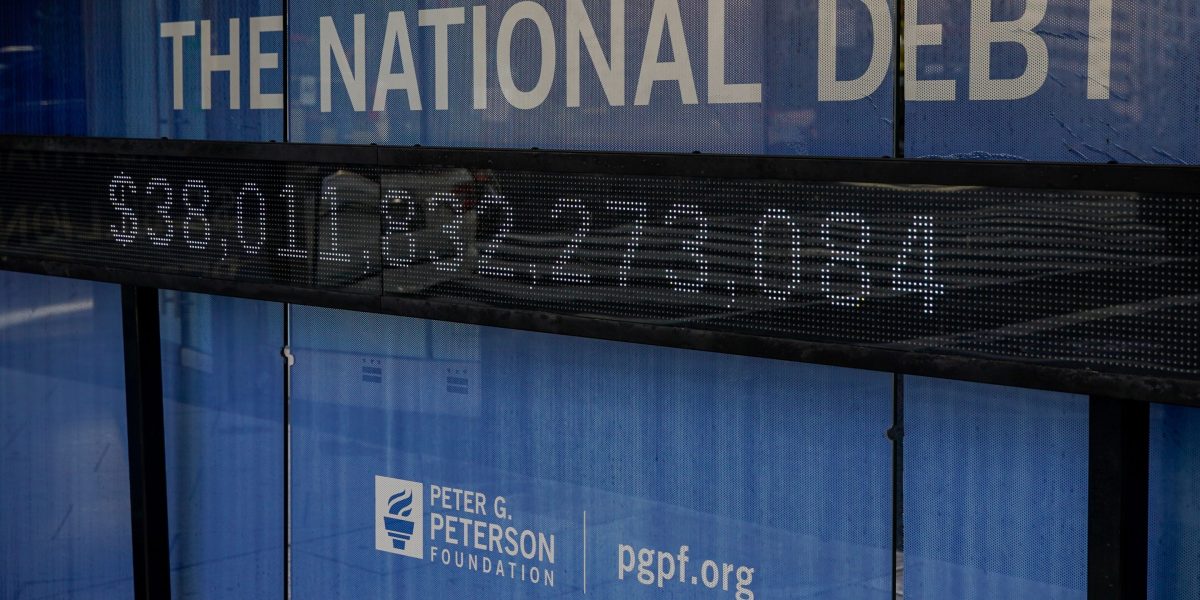
"One way or another, U.S. debt will stop expanding unsustainably, but the most likely outcome is also among the most painful, according to Jeffrey Frankel, a Harvard professor and former member of President Bill Clinton's Council of Economic Advisers. Publicly held debt is already at 99% of GDP and is on track to hit 107% by 2029, breaking the record set after the end of World War II. Debt service alone is more than $11 billion a week, or 15% of federal spending in the current fiscal year."
"In a Project Syndicate op-ed last week, Frankel went down the list of possible debt solutions: faster economic growth, lower interest rates, default, inflation, financial repression, and fiscal austerity. While faster growth is the most appealing option, it's not coming to the rescue due to the shrinking labor force, he said. AI will boost productivity, but not as much as would be needed to rein in U.S. debt."
""There is one possibility left: severe fiscal austerity," Frankel added. How severe? A sustainable U.S. debt trajectory would entail elimination of nearly all defense spending or almost all non-defense discretionary outlays, he estimated. For the foreseeable future, Democrats are unlikely to slash top programs, while Republicans are likely to use any fiscal breathing room to push for more tax cuts, Frankel said. "Eventually, in the un foreseeable future, austerity may be the most likely of the six possible outcomes," he warned."
U.S. publicly held debt stands at about 99% of GDP and is projected to reach roughly 107% by 2029, with debt service exceeding $11 billion weekly, about 15% of federal spending. Potential remedies include faster economic growth, lower interest rates, default, inflation, financial repression, and fiscal austerity. Demographic trends limit growth prospects and AI-driven productivity gains are unlikely to be sufficient. The prior era of unusually low interest rates appears anomalous. Default and inflation carry severe costs, financial repression would force distorted bank behavior, and sustainable debt stabilization would require deep spending cuts or comparable fiscal measures.
Read at Fortune
Unable to calculate read time
Collection
[
|
...
]